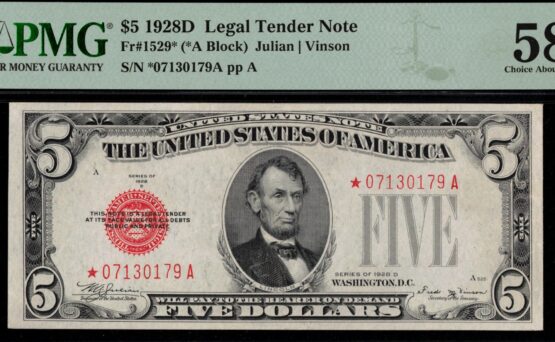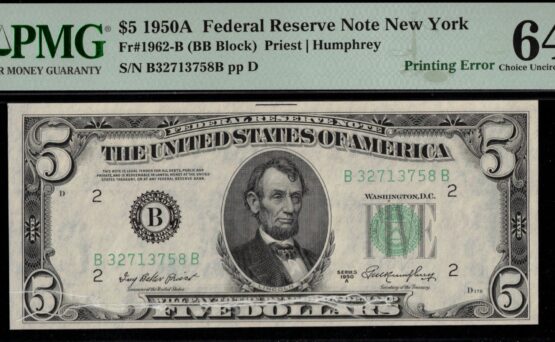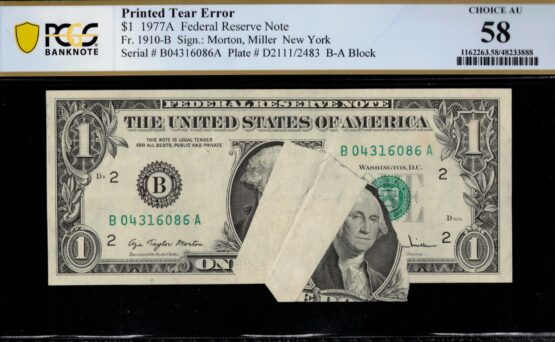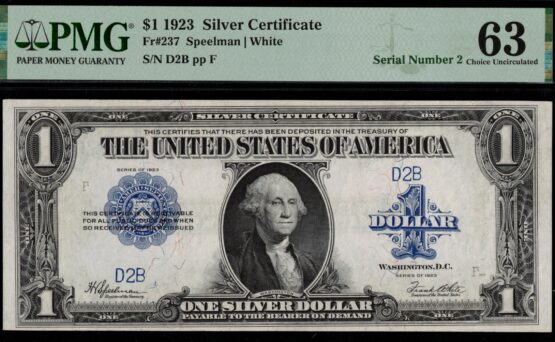
UNITED STATES NOTES.  1862-1863-1869-1874-1875-1878-1880-1901-1907-1917-1923 SERIES.
United States Note, also known as a Legal Tender Note, was a type of paper money that was issued from 1862 to 1971 in the U.S. Having been current for over 100 years, they were issued for longer than any other form of U.S. paper money. They were known popularly as "greenbacks" in their day, a name inherited from the Demand Notes that they replaced in 1862. They were called United States Notes by the First Legal Tender Act, which authorized them as a form of fiat currency, but because their value derives from their status as legal tender they bear the inscription "This Note is a Legal Tender" and are often called Legal Tender Notes. They were originally issued directly into circulation by the U.S. Treasury to pay expenses incurred by the Union during the American Civil War. Over the next century, the legislation governing these notes was modified many times and numerous emissions were undertaken by the Treasury.                      

FR-19 1874
$1.00
PMG #65 EPQ
H6888742  NICE TYPE NOTE  GREAT COLOR                                 
$3000.00

High graded legal tender note. Tuff 1874 series.                           
FR-40 1923 $1.00
P.M.G #64EPQ
A66B
$2400.00

Excellent two digit serial number on this FR-40.
FR-40 1923 $1.00
P.C.G.S #65PPQ
A1884B
$1350.00

Low serial number for this issue. Plus a nice high grade type note. #65.
FR-40 1923 $1.00
P.C.G.S #66PPQ
A1881B  *RADAR*
$2100.00

High grade mini radar serial number.
SILVER CERTIFICATES.  1886-1878-1880-1886-1891-1896-1899-1908-1923 SERIES
The Coinage Act of 1873 placed the United States on the gold standard, which replaced the gold and silver bimetallic standard that had been created by Alexander Hamilton. Many of the poorer citizens saw this as a "crime," and silver agitation began. The Bland-Allison Act, as it came to be known, was passed by Congress on February 28, 1878. It did not provide for the "free and unlimited coinage of silver" demanded by Western miners, but it did require the United States Treasury to purchase between $2 million and $4 million of silver bullion from mining companies in the West, to be minted into coins that would be legal tender for all debts, like gold. These coins, however, were quite heavy, so the government applied their gold certificate strategy to the silver. Suppose that there were five silver dollars in the treasury. The government would print a $5 Silver Certificate against the dollars, providing a somewhat easier medium of exchange. The idea was kept, and Series 1878 was printed in denominations of $10 to $1000
FR-224 1896
$1.00
VF/XF
>86<      $2490.00

Once a presentation note. A super low serial number. Even autographed on the reverse of the note.
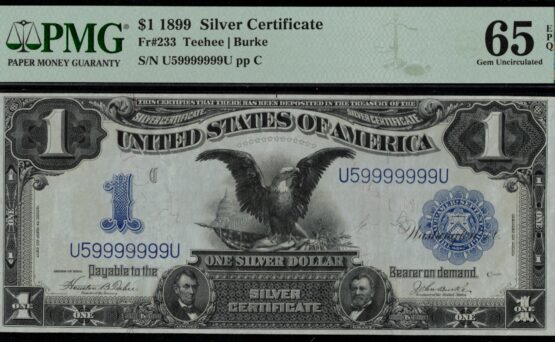
FR-228 1899 D
$1.00
XF
T66666666 
$6400.00

Full eight digit solid serial number. Very rare.

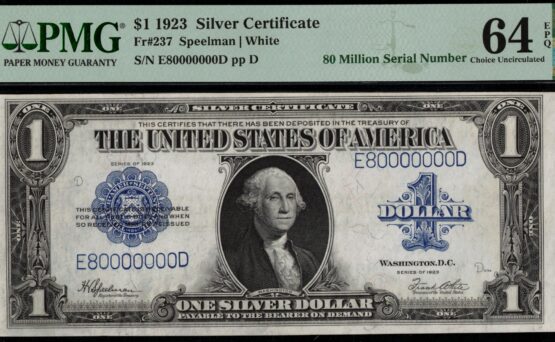
FR-237 1923 T
$1.00
CH-CU
K1B-K2B-K3B
$85,000.00

Almost a cut sheet. Still the ONLY serial one note known in private hands. The other A1D is locked in a museum.   Pic of  K2B-K3B
FR-237 1923 D
$1.00
CH-GEM
A17D-A18D-A19D-A20D
$8200.00

Lowest cut sheet known not to of been split up from the first sheet run AD BLOCK.
FR-237 1923
$1.00
P.C.G.S 65-66PPQ
K53B-K54B-K55B-K56B
$4600.00

Lovely graded cut sheet of four notes. #2 P.C.G.S #65PPQ AND #2 P.C.G.S #66PPQ.   Plate Position A-B-C-D
FR-277 1899
$5.00
P.C.G.S #12
M16161616
$1100.00

Only repeater serial number to ever show up on a large size CHIEF. Incredible Note.
FR-281 1899
$5.00
P.C.G.S #65 PPQ
SUPERB CHIEF-BRIGHT AND FRESH!!!!!!
$6400.00

In the 65 gem category for this PCGS graded chief note. With pure paper quality to boot.

TREASURY NOTES.

OUT OF STOCK
FEDERAL RESERVE BANK NOTES. 1915-1918 SERIES
1915: Federal Reserve Bank Notes (not to be confused with Federal Reserve Notes) were issued by 5 Federal Reserve Banks. The obverse was similar to the 1914 Federal Reserve Notes, except for large wording in the middle of the bill and a portrait with no border on the left side of the bill. Each note was an obligation of the issuing bank and could only be redeemed at the corresponding bank 1918: The 1915 Federal Reserve Bank Note was re-issued under series 1918 by 11 Federal Reserve banks
FR-740-1918 T
$1.00
V CH-CU
K1A-K2A   F.R.B.N OF DALLAS
$70,000.00

The first two notes from the sheet printed on the dallas district. Both are as nice as the first day printed. Rare serial #1 on a large size FRBN.   PIC OF K2A
FR-774 1918
$2.00
P.M.G #65EPQ
J105A F.R.B.N OF KANSAS  CITY
$7150.00


What more could you ask for? $2.00 battleship, graded GEM #65EPQ, with a low serial #105 to boot.
FEDERAL RESERVE NOTES.  1914-1918 SERIES
The first institution with responsibilities of a central bank in the U.S. was the First Bank of the United States, chartered in 1791 by Alexander Hamilton. Its charter was not renewed in 1811. In 1816, the Second Bank of the United States was chartered; its charter was not renewed in 1836, after it became the object of a major attack by president Andrew Jackson. From 1837 to 1862, in the Free Banking Era there was no formal central bank. From 1862 to 1913, a system of national banks was instituted by the 1863 National Banking Act. A series of bank panics, in 1873, 1893, and 1907 provided strong demand for the creation of a centralized banking system. The first printed notes were Series 1914 and in 1928 in order to save millions of dollars the size of the note was reduced to the size it is today.

OUT OF STOCK
GOLD CERTIFICATES. 1882-1888-1900-1905--1906-1907-1913-1922 SERIES
The gold certificate was used from 1882 to 1933 in the United States as a form of paper currency. Each certificate gave its holder title to its corresponding amount of gold coin. Therefore, this type of paper currency was intended to represent actual gold coinage. In 1933 the practice of redeeming these notes for gold coins was ended by the U.S. government and until 1964 it was actually illegal to possess these notes. (In 1964 these restrictions were lifted, primarily to allow collectors to own examples legally; however the issue technically converted to standard 'legal tender' with no connection to gold.) When U.S. paper money was modernized (made smaller, with fewer variations or "types", as with current paper money) in 1928, gold certificates ceased to be issued.

OUT OF STOCK